How the Words to Minutes Calculator Works
The words to minutes calculator turns a raw word count into a practical time estimate. Whether you are preparing a speech, writing a video script, or planning a lesson, knowing how long your content will actually take to deliver is essential — and guessing is rarely accurate.
The tool uses two widely accepted averages. For silent reading, it applies 200 words per minute, the standard rate for an average adult reading everyday prose. For spoken delivery, it applies 150 words per minute, which accounts for the pauses, emphasis, and enunciation that natural speech requires. Your word count is divided by the relevant rate and rounded up to the next full minute.
How to Use the Calculator
The calculator supports two input modes, so you can use whichever fits your workflow:
- Choose a mode: Use the toggle at the top to switch between "Paste text" and "Enter word count".
- Paste text mode: Paste or type your draft into the text editor. The word count is detected automatically and the reading and speaking times update in real time.
- Enter word count mode: If you already know your word count, type it into the numeric field. The times recalculate instantly without needing to paste any content.
- Read your results: The two cards show your estimated reading time and speaking time in minutes, each based on its standard words-per-minute rate.
- Adjust as needed: Edit your text or change the entered word count until the estimated time matches your target length.
Common Uses for a Words to Minutes Calculator
Presentations & Speeches
Stay within your allotted stage time by checking the speaking time before you rehearse. Aim to finish around 10% under your limit to leave room for pauses and audience reactions.
Video & Podcast Scripts
Predict the final length of a YouTube video or podcast episode from your script alone, before you ever press record. Use the speaking time figure for voiceover planning.
Classroom Timing
Teachers and trainers can estimate how long a reading passage or activity will take, helping pace lessons and keep a class on schedule.
Meeting Agendas
Plan talking points and briefing documents to fit a fixed meeting slot, so discussions stay focused and every item gets the time it needs.
From the Page to the Stage: How Writing Becomes Spoken Time
Written material and spoken delivery run at different speeds. When you read silently, your eyes move faster than your mouth ever can, and your brain fills in gaps without effort. When you speak the same words aloud, you have to articulate every syllable, pause for breath, and give listeners time to absorb each idea. That is why the same text takes noticeably longer to deliver than to read.
The words to minutes calculator bridges that gap. It takes a word count and translates it into an estimated delivery time using a standard speaking rate of 150 words per minute. This gives you a practical starting point for planning a talk, a lesson, or a recording, long before you stand up to deliver it.
Think of the estimate as a floor, not a finish line. It tells you roughly how long the words themselves will take to say. Everything else that happens during a real delivery, the pauses, the emphasis, the moments where you wait for an audience to react, adds time on top of that baseline.
Speaking Speed Varies, and So Does Real Delivery Time
No one speaks at a perfectly steady rate. Speaking speed varies from person to person and from moment to moment within a single talk. A nervous presenter may rush through 180 words per minute, while a careful storyteller may linger closer to 120. The 150 words per minute figure is a useful average, but your own pace may fall above or below it.
Beyond raw speed, many factors stretch the actual time a piece takes to deliver. None of them appear in the word count, yet all of them shape how long you will be on your feet:
- Pauses for breath, for effect, or to let an important point land.
- Emphasis and changes in tone, which slow you down as you lean into key words.
- Audience interaction, including questions, reactions, laughter, and moments where you wait for a room to settle.
- Slides and visuals, which add time as you reference them, wait for people to look, or talk through a diagram.
- Demonstrations, where you step away from the script to show something physically or on screen.
- Stories and examples that expand beyond the written text as you ad-lib or add detail.
Because of these factors, a script that estimates ten minutes may easily run twelve or thirteen in front of a real audience. Plan for that cushion, especially when you have a hard time limit.
Who Uses a Words to Minutes Tool
Anyone who has to turn written words into spoken time can benefit from estimating delivery length in advance. A few common examples:
Speakers
Public speakers check whether a draft fits their allotted slot before stepping on stage, and trim or expand it to land comfortably under the limit.
Presenters
Business presenters pace slide decks and briefing talks so each section gets the right amount of time without running over.
Teachers
Teachers estimate how long a reading passage or explanation will take, helping them keep lessons on schedule.
Pastors
Pastors and religious speakers plan sermons to fit a service window, leaving room for music, prayer, and response.
Video Creators
Video creators predict the final length of a voiceover or narration from a script alone, before recording a single take.
Podcasters
Podcasters gauge episode length from a written outline or full script, so they can plan segments and publishing schedules.
Trainers
Corporate trainers and workshop leaders time modules and activities to fit a session without rushing the material.
Students
Students rehearsing class presentations, debates, or oral reports check that their speech fits the time they have been given.
How Many Words Is a 20-Minute Sermon?
About 2,500 words. At a steady preaching pace of 125 words per minute, 20 minutes is about 2,500 words of continuous speaking. If you speak closer to the calculator's 150 words per minute average, the same 20 minutes holds about 3,000 words.
A sermon is not 20 minutes of nonstop talking, though. Reading scripture slowly, pausing for emphasis, and leaving room for a response all take time. That is why most 20-minute manuscripts land closer to 2,300 scripted words.
Sample 20-Minute Sermon Outline (125 words per minute)
| Section | Purpose | Time | Words |
|---|---|---|---|
| Scripture Text | Read the passage aloud, unhurried | 2 min | ~200 |
| Big Idea / Theme | State the one truth you want people to remember | 1 min | ~125 |
| Opening | Connect the message to everyday life | 2 min | ~250 |
| Main Point 1 | Explain and support the first point | 3 min | ~375 |
| Main Point 2 | Explain and support the second point | 3 min | ~375 |
| Main Point 3 | Explain and support the third point | 3 min | ~375 |
| Illustrations / Stories | One story or example that makes it stick | 2 min | ~250 |
| Application | What listeners can do this week | 2 min | ~250 |
| Closing / Invitation | Summarize and invite a response | 1 min | ~125 |
| Pauses & response | Breaths, emphasis, and moments of silence | 1 min | not scripted |
| Total | 20 min | ~2,300 |
Paste your manuscript into the calculator above to check it, then rehearse out loud and time yourself. If your rehearsal runs long, trim a main point or shorten an illustration rather than speaking faster.
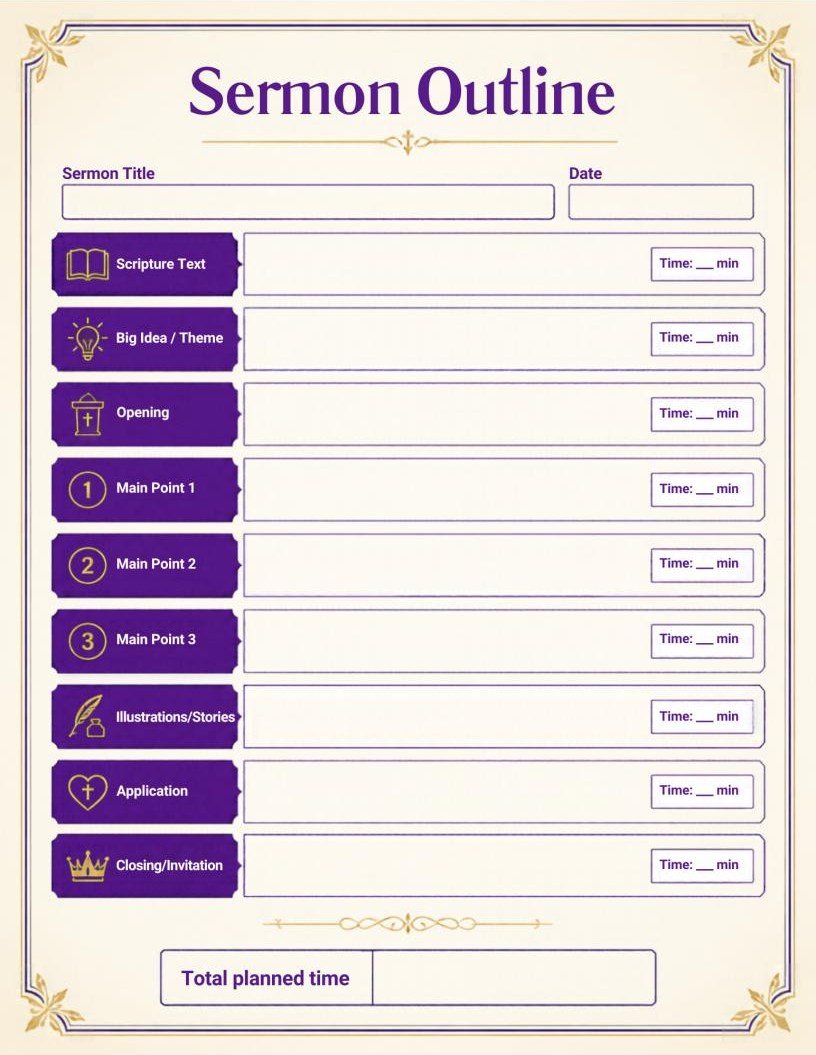
Want this outline on paper?
The Sermon Outline page in the printable Sermon & Speech Timing Planner has a time box for every section above, plus a words-to-minutes chart, a service timing sheet, and a rehearsal log.
Get the printable plannerThe Best Final Check: Rehearse Aloud
The words to minutes calculator is a planning tool, and a good one, but no estimate can fully predict a live delivery. The only way to know how long your material truly takes is to rehearse it aloud, at the pace you intend to deliver it, with the pauses and emphasis you plan to use.
Reading a script silently in your head almost always underestimates the real time, because silent reading is faster than speaking and skips over the pauses. When you rehearse aloud, you discover where you naturally slow down, where you need a breath, and where an audience might need a moment to catch up. You also hear which sentences trip you up, which is valuable feedback the calculator cannot give you.
Use the calculator to get close, then rehearse the finished material aloud to lock in the real time. If your rehearsal runs longer than your slot, trim. If it runs short, you have room to add a story or take questions. Treat the estimate as your starting point and the rehearsal as your final check.
Recommended Speaker Tools
As an Amazon Associate I earn from qualifying purchases.
Logitech R500s Presentation Clicker
Control your slides while you move around the room.
View on AmazonTONOR Wireless Lavalier & Headset Mic System
Hands-free sound for sermons, teaching, and talks.
View on AmazonFrequently Asked Questions
Where do the 200 and 150 words-per-minute figures come from?
200 words per minute is the widely accepted average reading speed for an adult reading standard prose. 150 words per minute is a common average for clear spoken delivery, which is slower because it includes pauses, breathing, and emphasis for an audience.
Why is speaking time slower than reading time?
When reading silently, your brain processes words faster than your mouth can say them. Speaking requires physical articulation, pauses for breath, and pacing so listeners can follow along, which brings the average rate down to around 150 words per minute.
How accurate are the estimates?
The estimates are a reliable guide for typical content, but real times vary. Technical material, complex vocabulary, and on-screen visuals all slow readers and speakers down. Treat the result as a planning estimate rather than an exact measurement.
Can I use this without pasting my text?
Yes. Switch to "Enter word count" mode and type a number directly. The calculator will convert that word count into reading and speaking minutes without needing your full document.
Is my text stored or uploaded anywhere?
No. When you use "Paste text" mode, all analysis happens locally in your browser. Your text is never uploaded, saved, or sent to any server, so you can safely paste sensitive content.
Is the speech time an exact measurement?
No, it is an estimate. The calculator applies an average speaking rate of 150 words per minute, but real delivery time varies with your personal pace, pauses, emphasis, audience interaction, slides, and demonstrations. Treat the figure as a planning guide, then rehearse your material aloud to confirm the actual time.
Can I use this tool for presentations, sermons, lessons, and scripts?
Yes. The calculator works for any spoken material, including business presentations, sermons, classroom lessons, video and podcast scripts, training modules, and student talks. Wherever you need to turn written words into an estimated delivery time, the tool gives you a reliable starting point.
How many words is a 5-minute speech?
About 650 to 750 words at a natural speaking pace of 130–150 words per minute. Slow, deliberate speakers may need closer to 600 words.
How many words can I read aloud in 10 minutes?
Most people read aloud 1,300 to 1,500 words in 10 minutes. Add extra time for pauses, slides, or audience interaction.